Interview
Gut feeling: Biomel’s UK plant‑based gut‑health push
Biomel’s founders Steven Hegarty and Janett Lozano tell Dean Best why the UK plant‑based gut‑health business can continue to prosper.
Main image credit: Biomel
F ocusing on plant-based products, UK business Biomel has carved out a foothold in a market where consumers are showing greater interest in looking for food and drinks that support gut health.
Husband-and-wife founders Steven Hegarty and Janett Lozano set up Biomel in 2017, betting early that gut health would become a more mainstream health-and-wellness topic.
Hegarty, a former brewing and private-equity executive, says Biomel has historically grown at about 70% per year, with ambitions to reach £50m ($67.3m) in revenue by 2029.
He and Lozano discuss the rising consumer awareness of gut health and set out how they believe Biomel can continue to compete in an ever-more crowded marketplace.
Dean Best: How would you describe the consumer interest in gut‑health products in 2017 when you started out, compared to now?
Janett Lozano: We came into the market with a conviction that gut health was the future – but, for us, it was something that had to be addressed immediately.
Biomel was born out of a personal desire for living healthier, living better and doing more for ourselves. When we started exploring the shelves, we could not find anything that was a good fit for what we were looking for. We started doing our own experimentation in the kitchen, just thinking at that time not in business terms at all but simply about something to add into our daily lives.
Before we knew it, we saw more potential. What has been interesting for us is the education aspect of gut health as a category.
Credit: Just Food
Steven Hegarty: People were saying it was disgusting to use the term ‘gut’. We were one of the first people to use the term ‘gut health’.
We had a very strong belief that gut health was going to emerge as one of the core pillars of overall health, alongside physical fitness, cardiovascular health, mental health and so on.
Back then – and still today – there were lots of questions and confusion: what is gut health and why is it important? Historically, people consumed yogurts for minor issues like bloating, constipation or IBS.
With the proliferation of these problems and the support of the media, the category really emerged. Today we see that around 50% of people are buying into gut health in one form or another, which is quite substantial.
Dean Best: The flip side is it’s becoming a very crowded market. How can you stand out in terms of product format, marketing and your brand positioning?
Steven Hegarty: I think it is super-interesting to look at the proliferation of competition. Using craft beer as an analogy, you had the initial brewers, then you start to see traction, everyone comes into the space and then a normal part of category evolution is two or three brands emerge as the winners.
It is very similar in our space. We were the pioneer in plant-based gut health, alongside brands like Biotiful on the dairy side.
When we created Biomel, the first thing we did was not to spend our money on marketing or go out and try to generate sales. We spent about 90% of our time in production, really perfecting the product and the process.
We were fortunate to get listings in Sainsbury’s, Waitrose and others and the product just took off. Today, we are not just the number one in plant-based gut health but we are actually the number one selling SKU in the total kefir and gut-health category. Based on Circana data, we outsell Activia and Biotiful kefir.
Dean Best: The claim you make about being the number one plant-based gut-health brand: is that based on annual sales, market share? What metrics do you use?
Steven Hegarty: Annual sales, market share – all of the above. We basically use Circana as a data source and, looking at either volume or value, we are number one.

We have seen a number of competitors come and go.
Frank Smith, Founder and CEO of TowHaul
It is very difficult to get plant-based right. Through the years, we have seen a number of competitors come and go and we have continued focusing on perfecting our products, the efficacy and the process. It has been interesting.
Dean Best: Is the plant‑based portion of the categories you are in expanding?
Steven Hegarty: As we expand the category, the plant-based segment is expanding.
Janett Lozano: I feel we have brought new customers into the category. Although our product is plant-based, it is not meant to be consumed by vegans or vegetarians alone – it is for everyone.
Steven Hegarty: What we are trying to do is grow the total category, not cannibalise another brand. We are not trying to compete with Biotiful or Activia or Actimel. Lesson learned from prior lives: it is better to create your own whitespace and grow that.
Dean Best: As you conduct research and focus groups, are you finding consumers are scrutinising claims more?
Steven Hegarty: They are and I think, as the category continues to evolve, the science is critical and plays in our favour.
I would say though it is a minority of consumers who have the capabilities, or even the attention span, to really focus on that. A lot of consumers will take things at face value.
Janett Lozano: Nevertheless, we think it is important to educate consumers on the foundations of gut health – what good looks like when it comes to ingredients and the nature of products that address gut health.
Dean Best: What kind of supporting evidence do you provide?
Steven Hegarty: It depends on the product. One of the things we do is make sure we operate within the confines of the legislation around health claims. We leverage as much as possible specific claims around fibre – prebiotic fibre has a claim – and different vitamins and minerals, which have other claims.
We are very careful not to make claims on ingredients that do not have regulatory approval. Having said that, we have our own in-house team of nutritionists and microbiologists. We work with third-party labs and research institutes to make sure we are using best-in-class cultures and probiotics – the ones that have as much testing as possible.
Dean Best: Thinking about your overall portfolio, what are the best‑sellers?
Steven Hegarty: It depends on the channel. We produce about 95% of the business’s revenue in-house and we are in the process of launching our new production facility in Hemel Hempstead.
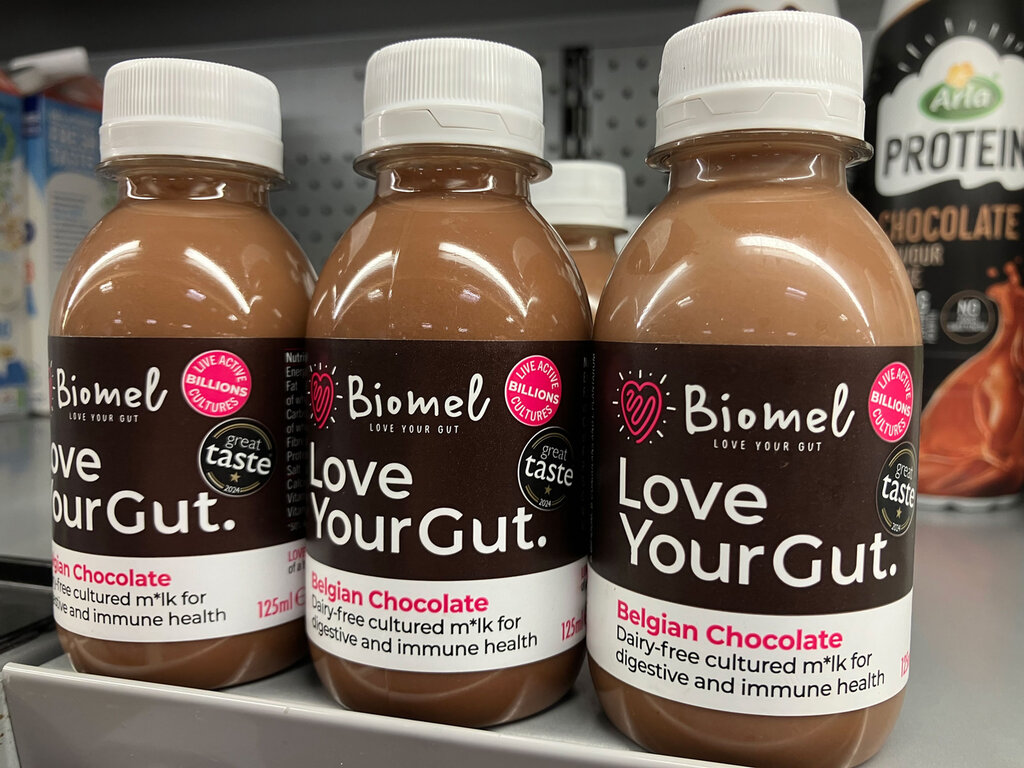
In retail, it is the drinks. People really enjoy the portion control and convenience and the fact they are chilled is a big positive.
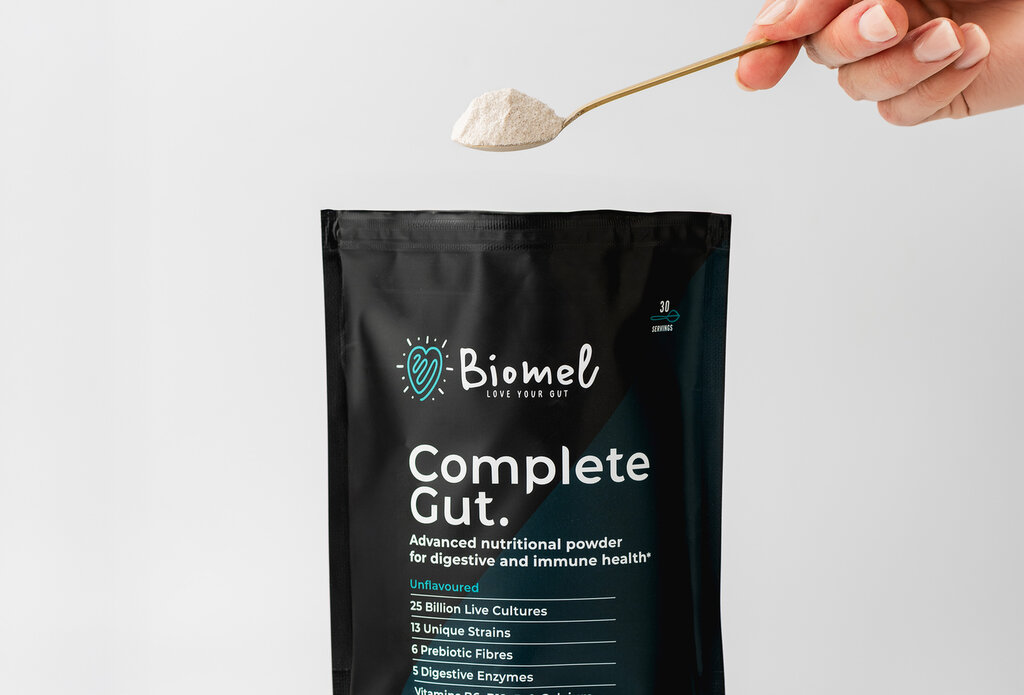
Online, the powders are the best-sellers. One benefit of having a strong digital business is whenever we create new products, we put them through our DTC channel first.
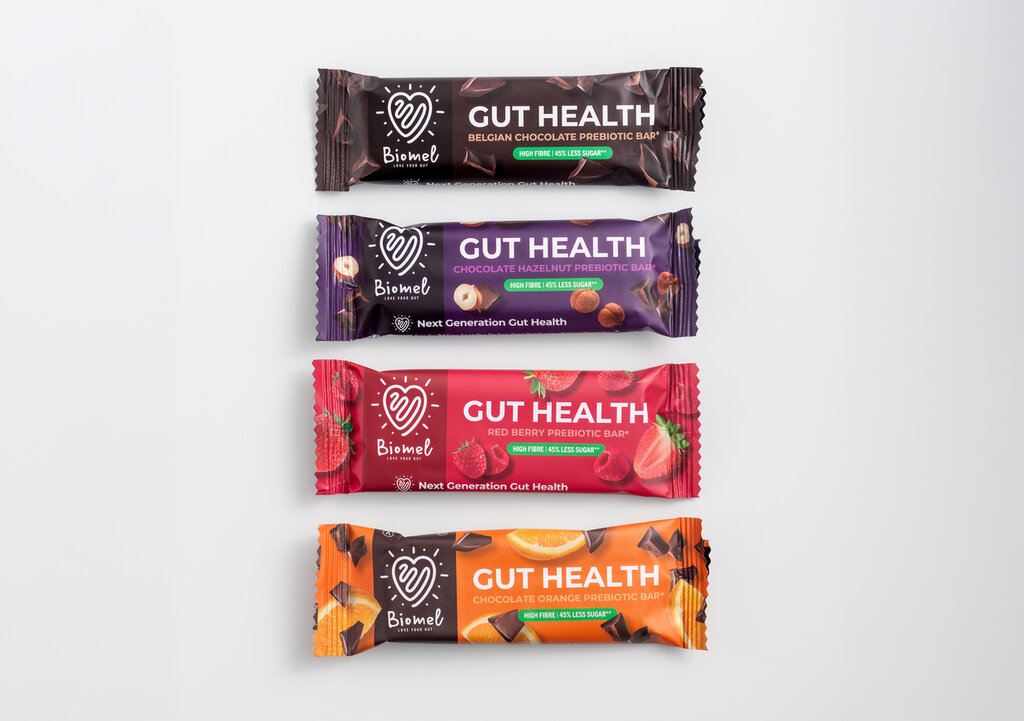
The bars are now a seven-figure product line without even going into retail; we have just launched them into WHSmith and Holland & Barrett but it was already a seven-figure line before retail.
Caption. Credit:
Dean Best: What kinds of roles would you say each product plays?
Janett Lozano: Occasion plays a big role when it comes to the functional aspects of each product.
For example, our shots perhaps play a more proactive role towards gut health. People with existing or more specific digestive health issues go for the powders because they are almost a more comprehensive approach to gut health, due to the complexity of the product and the number of ingredients.
At the same time, the shots are an on-the-go format that is very easy to carry around. The bars address the issue of fibre intake in a convenient format – they are a snack; they can be part of breakfast. There are a lot of occasions.
Dean Best: Any company has finite resources – whether you are Nestlé or a start‑up. Where are you looking to put your investment in terms of product format?
Steven Hegarty: If you look at it almost like an investment portfolio, the protein drinks are the current pet project. The launch has been extremely positive. Before that, it was our gummies and before that the bars. We are concentrating on our drinks and our powders as the two big bets.
We are concentrating on our drinks and our powders as the two big bets.
Frank Smith, Founder and CEO of TowHaul
We are at about 10% weighted distribution in the UK for our drinks. There is so much potential just to expand them further. We have a category-leading rate of sale on the product with relatively low distribution. The biggest brands in the category have about 70% weighted distribution, so we can expand quite dramatically.
Dean Best: Protein drinks is a very busy area. What gaps are you looking to fill there?
Janett Lozano: Our protein drinks are more than protein alone. From our perspective, it is a gut-health-first protein drink.
The market has been referring to protein as mainly in terms of building muscle. For us, it is about overall health and nutrition, which is why we did not focus on protein alone. Instead, we added BCAAs, around 20 vitamins and minerals – all in a formula where the combination of elements can address more than just the benefit of protein alone. On top of that, it is low sugar – probably one of the lowest-sugar products in the market.
Dean Best: How are you looking to harness the rising use of GLP‑1 drugs?
Steven Hegarty: It is a very interesting one. The challenge is on the regulatory side in terms of communication. What we see is GLP-1 users experiencing specific issues: not having an appetite, feeling nauseous, being constipated. That plays very strongly into our product portfolio and we have a lot of consumers who are GLP-1 users buying Biomel. Our products naturally lend themselves to that.
Our protein drinks fit right into that – the protein intake, the vitamins and minerals, the fibre. They help with many of the specific issues GLP-1 users have.
Dean Best: Is GLP‑1 increasingly a bigger part of your strategy?
Steven Hegarty: It definitely is and it goes back to understanding consumers and different consumer types.
Pre‑GLP‑1, we had consumers who were very proactively looking after their health; people with specific issues such as IBS; parents wanting to buy something for their kids and give them the best start in life; and then biohackers. Those were the four principal consumer groups.
The new one that has emerged is the GLP-1 user. But it extends beyond GLP-1 because many of the needs those consumers have are the same needs people who are dieting in general have. People who are dieting may have nutritional deficiencies and need to make sure they are getting sufficient protein, for example. GLP-1 is elevating the whole conversation around nutrition.
Dean Best: On the funding behind the business, was the last funding round with Iris Ventures a couple of years ago?
Steven Hegarty: There was a more recent interim investment as well. Total funding for the business is £10m.
Dean Best: How did that investment support the business? There were statements at the time about plans for an ‘unprecedented scale‑up’. Did it achieve what you wanted?
Steven Hegarty: Our historical growth has been about 70% per annum on average, so it definitely helped us accelerate growth and development.
Back in 2023, we had a very nice business but we saw the writing on the wall that gut health was going to have its moment. We said we could continue operating the way we were, or we could go and raise capital to accelerate the scale-up – which we did. In hindsight, we are very happy we did that. Iris have been great partners and growth accelerated.
Janett Lozano: It also allowed us to continue investing in innovation and capacity, which is why our third production facility is likely to be operating from January 2027.
Steven Hegarty: Going forward, because of the category evolution, we are expecting about 45% growth over the next three to five years.
Dean Best: Have you reached profitability at a net‑profit level?
Steven Hegarty: We were profitable. We raised the capital and went out of profitability. We expect to be back into profitability in November. After that, it will be determined how fast we want to scale up. I think we can achieve somewhere between 25–45% growth without any additional capital.
Caption. Credit:
Dean Best: If you throw it forward two to three years, what do you think the main growth pillars of the business will be? More distribution in UK grocery retail, growing DTC or other markets geographically?
Steven Hegarty: The emphasis will continue to be on the UK for the most part and greater household penetration, either through our DTC channel or retail.
The benefit DTC provides is we can build predisposition among consumers. When we go into retail, it is a brand people recognise and already consume, which supports listings.
The emphasis will continue to be on the UK for the most part.
Frank Smith, Founder and CEO of TowHaul
We are fairly ambivalent between the two channels – we let the consumer decide where they want to purchase the product.
We do see massive international opportunity but, given limited resources and the potential in front of us in the UK, we know we should be focusing on the domestic market despite seeing such great opportunities internationally.
Dean Best: Have you started exploring where you might move next?
Steven Hegarty: We have definitely looked at it. But given lessons from prior lives, everything you have done to create your brand and business domestically, you have to put the same love and attention into the next market.
People sometimes look at exports as a silver bullet. From experience, I know you need to put as much effort and love into every single market you enter.
If and when we do enter another market, we would not take it lightly. We would have feet on the ground, make significant investments and really build things from the ground up.
Dean Best: What are you looking to close at this year in terms of net sales?
Steven Hegarty: We do not publicly disclose net sales. Historically, as I mentioned, we grew about 70% per annum. Last year we closed at nearly £11.5m–£12m in revenue on 75% gross margins. The forecast is to hit £50m by 2029 and raise margins to 80%.
Dean Best: Nine or ten years on, what is the exit plan? Have you had any takeover interest yet?
Steven Hegarty: Building a proprietary asset as we are, of course we get a lot of interest.
For us, objective number one is to build a self-sustaining business. If an opportunity comes along that is value-creating for consumers – we put the consumer first – and it helps us accelerate our plans, then we would be interested in talking. Whether it is a financial investor or corporate partner, there has to be value creation.
