
Feature
How consumers find you now: food brands and AI agents
As more shoppers use AI agents, brands must review how they get their products in front of consumers. Simon Creasey reports.
Main video credit: Trump card / Shutterstock.com
H istorically, shoppers and food manufacturers have had a relatively straight forward relationship. Brand loyal shoppers would regularly pick their favoured manufacturer’s product from the supermarket shelf, or click to add it to their online shopping basket, or they might be persuaded to try a new product after seeing an a TV or online ad.
Thanks to AI, it’s becoming more complicated. Shoppers are increasingly adopting AI in some way on a daily basis for product research or price comparison to the more sophisticated use of AI ‘agents’ to compile shopping lists.
According to one industry source, some retailers estimate up to 30% of their online traffic could be agentic by 2028. What do food manufacturers need to do to ensure they ‘win’ on shelf in this new AI-powered future?
Back to drawing board
Earlier this year, data and AI company EXL and HFS Research surveyed 101 senior US retail and consumer brand executives about AI. Their report was titled Brands have 24 months to win over the AI shopper and its findings were eye-opening.
Some 84% of survey respondents said they expect agent-led shopping to affect revenue within two years and 71% see it as a serious or existential threat, yet 68% have nothing live to manage the risk.
As Sangeetha Chandru, SVP for advanced AI and analytics at EXL, explains, AI is rewriting the rules of the game for brand owners.
“On the shelf you fight for space. With an agent you fight to be on its shortlist and to become its default choice. Once a customer’s agent settles on a preferred brand in a category, dislodging it costs far more than winning the spot early,” Chandru says. “That’s why repeat and replenishment purchases matter most, because a preferred brand there becomes a household habit. The risk is that brands which don’t show up in the agent’s consideration set never reach the customer at all.”
Some more enlightened food manufacturers are investing time and effort into ensuring their brands still register with the more AI-savvy consumer. It’s a strategy that requires putting a framework in place to optimise how brands perform on digital shelves rather than on physical ones.

AI shopping agents don’t see flashy banners – they read structured metadata, product attributes, verified reviews and claims.
Jenny Wilkinson, Mondelez International
“The shift from shelf-first to AI-first discovery means brands need to win on data quality and structured content, not just creative marketing,” says Jenny Wilkinson, US digital insights and analytics lead at Mondelez International. “AI shopping agents don’t see flashy banners – they read structured metadata, product attributes, verified reviews and claims.”
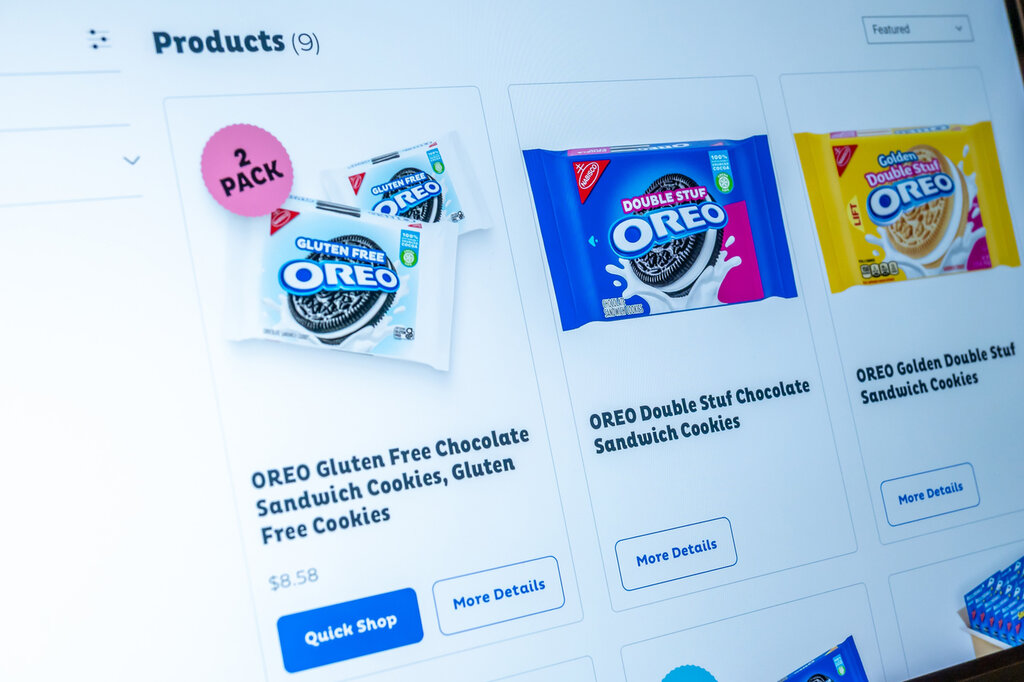
The Cadbury and Oreo owner says its ‘digital pillars’ of search, content, availability, assortment and activation, are the exact same signals AI shopping agents use to decide which products to recommend.
“If your search presence is weak, your content is thin, or your availability is inconsistent, an AI agent will skip you – just like a consumer would,” says Wilkinson. “We didn’t build this [digital framework] for an AI-first world but it turns out we built exactly what an AI-first world demands. The brands that have structured data, strong content signals and the measurement capability to optimise continuously, are the ones AI agents will surface. We’re in that position.”
Credit: agustin.photo / Shutterstock.com
Understand your consumer
UK sausage maker Porky Whites is one SME that relatively early on identified the challenge – and opportunity – AI presents. The business said it allowed AI platforms to index and reference key content such as products, recipes and news.
“It means any new content or updates are picked up and served to AI platforms and their users,” says Paul Van Wymeersch, head of marketing at Porky Whites. “With a background in search engine optimisation, I was able to action this myself and within a few months I saw a tangible change in both traffic to the site and visibility.”
The key thing to remember, according to Van Wymeersch, is AI is powered by data – by what it is able to read, understand and construct.
AI is a platform responding to a consumer’s wants and needs, so to ‘win’ you must first understand your consumer.
Paul Van Wymeersch, Porky Whites
“The more relevant information you feed it, the smarter it becomes and the more relevant the results it shows consumers. But AI is a platform responding to a consumer’s wants and needs, so to ‘win’ you must first understand your consumer. I’m not talking about the who – I’m talking about the what, the where, the why, the how, and the what ifs and buts, before grounding these back into your product. Once you understand these, you can assign data and build action plans – content, for example – to meet the right consumers, at the right time, with the right content, and earn the right response.”
Food discovery is changing and increasingly consumers aren’t just searching for products – they’re asking AI what to buy and cook and to find options that best fit their needs, says Olivia Kirby, director of integrated demand generation at Unilever.
“Every consumer is different, which is why we invest extensively in understanding what consumers are looking for,” says Kirby. “We use those insights to create a wide range of content designed to support and inspire them. What is changing is that this content now also needs to be visible, legible and understandable to AI, so that it can identify and understand our brands, surfacing our products when relevant to consumers’ needs.
“It’s about creating content that serves different consumer requirements, while making sure AI can understand and recommend that content too – and we’re already testing what that means in practice.”
Credit: Jonathan Weiss / Shutterstock.com
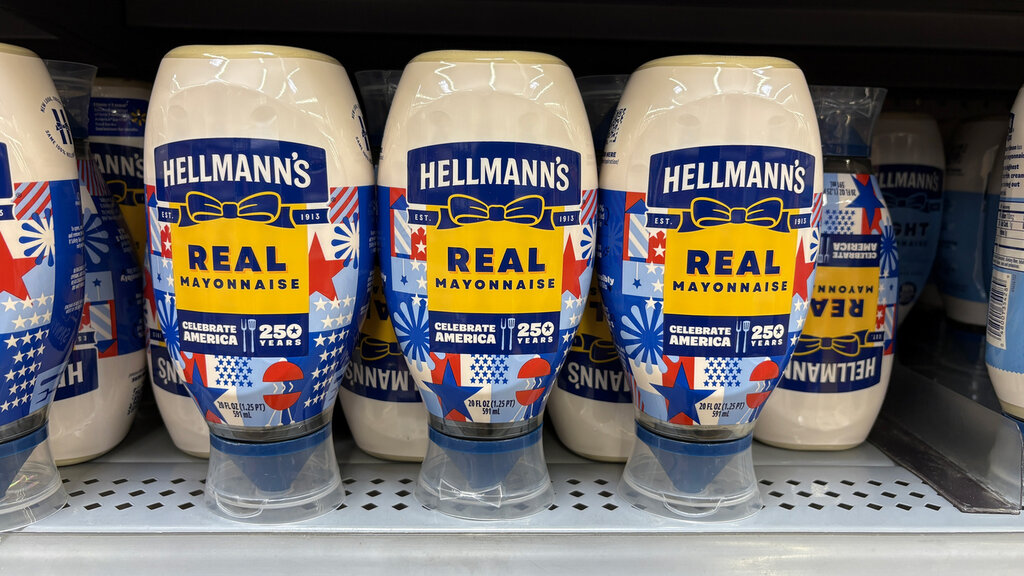
Kirby cites an example of how Unilever used AI tools to identify that the company needed to improve the awareness of its Hellmann’s brand among US consumers as they were preparing for the Super Bowl.
“We adapted the content and structure of our recipe pages to better answer those searches,” she explains. “This included updating descriptions with relevant keywords, reframing existing content into AI-friendly listicle formats and expanding the brand’s recipe section,” Kirby says. “This drove a double-digit increase in visibility score and stronger rankings, making Hellmann’s more likely to be recommended when consumers searched for relevant recipes.”
Keep it simple
However, while AI can help brands identify those kinds of opportunities, the technology is evolving so rapidly it’s difficult for manufacturers to know what they should be doing – and when – because the shopper is an agent rather than a human being.
“Brands were established because people trusted the brand to deliver quality. Private label came along because people trusted retailers to bring the right level of quality to their private label products. But now this is about trusting your digital assistant to do the curation for you,” says Cyrille Filott, global head for the consumer sector at Rabobank’s Food & Agribusiness practice. “That’s part of the equation that for a branded food company must be very difficult because how can you convince a digital assistant to try the product and try the new brand, or to make the recurring purchase? It’s a different type of consumer. It’s a different decision maker.”
Food manufacturers are at different stages of their adoption of AI, with some deploying the technology quickly across their business and others taking more of a watching brief and using a test-and-learn approach.
Nevertheless, there are some relatively straight forward, cost-effective steps manufacturers can take to try to ensure their brands remain visible and desirable, says Abhinav Agrawal, co-leader of AI monetisation at consultancy AlixPartners.
“Brands need to be easy for AI assistants to understand and compelling for consumers to choose,” he explains. “Accurate information on ingredients, allergens, nutrition and pack sizes should be consistent across brand websites and retailer listings. Manufacturers should ensure product information is reliable, brands should explain the product’s value in everyday meals and retailers should connect those details to current prices and availability. These are practical priorities to address alongside the brand investment that gives consumers a reason to seek out a particular product.”
The AI strategy rolled out by manufacturers should also be determined by where shoppers typically interact with their brands.
“For example, a brand sold mainly through supermarkets should concentrate on how its products appear and sell through retail partners, while a direct-to-consumer business may benefit from integrating shopping assistants into its own channels,” says Agrawal. “Manufacturers and retailers should test a few commercially important shopping occasions and expand the initiatives that demonstrate better conversion, repeat buying or margin. Every investment should have a business owner, a baseline and a clear threshold for further funding.”

Credit: Stockinq / Shutterstock.com
AI may be changing how consumers discover, compare and ultimately choose products but the fundamental job of marketeers hasn’t changed, according to Arthur Sylvestre, VP media and digital strategy for Danone in the US. You still have to earn consumer trust and give shoppers a reason to choose your brands.
“We now have to build that trust with people and credibility with AI agents that are increasingly helping them make decisions,” says Sylvestre. “At Danone, that means ensuring our brands and product information are consistent, authoritative and easily understood across the digital ecosystem, while continuing to create distinctive brands that people genuinely want. We’re well-positioned to do both and are actively driving this forward today.”
The pace of change
It could be argued AI presents the biggest threat to long-standing business models that food manufacturers have ever had to cope with.
Over the next 24 months, leaders will move from fixing data foundations to the commercial questions.
Sangeetha Chandru, EXL
It’s an area moving incredibly quickly and the tools and technologies are going to change rapidly over the coming months and years. While it may be difficult to predict with 100% certainty how things might play out, the direction of travel is clear, according to EXL’s Chandru.
“Over the next 24 months, leaders will move from fixing data foundations to the commercial questions: agreeing fees and data-sharing terms with agent platforms and measuring every agent-mediated sale for incrementality and margin from the first pilot. Brands will build for their own agents and third-party agents at the same time. The winners will be those who treat this as a data, analytics and AI challenge as much as a marketing one, and who act while agents are still forming their preferences.”
Mondelez’s Wilkinson agrees. “The brands that win won’t be the ones who predicted AI’s path perfectly. They’ll be the ones who built the data and measurement foundation to adapt fast.”
