Company Insight
Sponsored by TITAN Containers
Creating space to keep food moving
As food businesses navigate changing demand, seasonal peaks and increasingly complex supply chains, storage capacity can quickly become a constraint. Flexible, temperature‑controlled storage offers an alternative to permanent expansion, helping businesses respond to changing requirements while keeping their operations moving.
Main image credit:
For food businesses, storage capacity is closely linked to the ability to keep products moving. Demand can change quickly, seasonal peaks can put pressure on existing facilities, and growth can create new requirements for temperature-controlled space.
The challenge is that additional capacity is not always needed permanently. Building or expanding a cold-storage facility can require significant time, space and investment, even when the immediate requirement may be temporary.
Flexibility when demand changes
From seasonal increases in production to new customers or changing distribution requirements, food businesses need storage solutions that can adapt to their operations.
Flexible cold storage can provide additional capacity alongside existing facilities, allowing businesses to respond to changing requirements without immediately committing to permanent infrastructure.
For a food producer, this could mean managing a seasonal increase in output. For a distributor, it could provide additional space during a period of higher demand. For a business entering a new market or increasing production, it can provide capacity while longer-term plans take shape.
The requirement is different in each case. The important consideration is finding a solution that supports the operation rather than creating additional complexity.
Caption. Credit:
Making capacity work around the operation
Cold storage is not simply about having somewhere to store products. It needs to fit into the wider flow of the business.
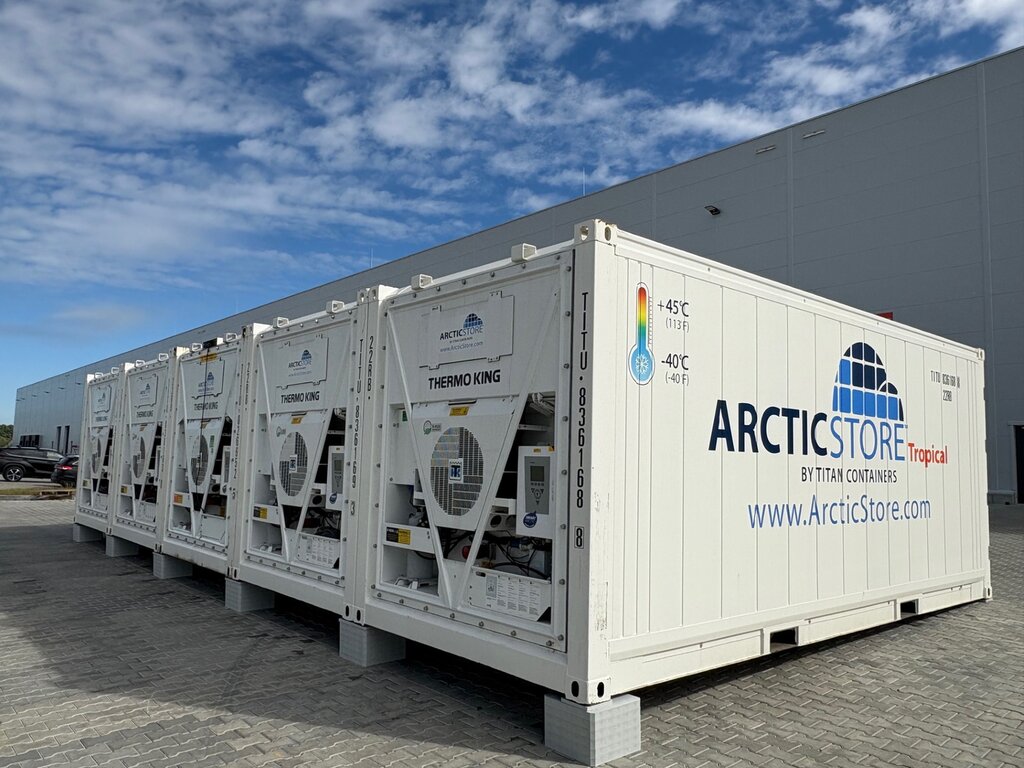
TITAN Containers provides containerised, temperature-controlled storage that can be deployed where additional capacity is needed. The units can be used alongside an existing facility or as a more flexible alternative where permanent space is limited.
This approach can be particularly relevant when demand is difficult to predict. Seasonal periods, promotional activity, changes in production or new customer contracts can all create temporary pressure on available storage.
Instead of investing in permanent capacity that may be underused once demand returns to normal levels, businesses can consider a more flexible approach that allows storage capacity to change with the requirement.
Supporting growth without creating a constraint
The same principle applies to business growth. Winning a new customer or increasing production is an opportunity, but insufficient storage capacity can quickly become a constraint.
Having access to additional temperature-controlled space can give businesses more options when circumstances change. Capacity can be introduced as requirements develop, allowing businesses to focus on production, distribution and customer demand while longer-term infrastructure decisions are considered.
With more than 35 years of experience in containerised storage, TITAN works with customers across the food supply chain to understand their operational requirements and develop solutions around them.
For some businesses, that may mean additional capacity for a few months. For others, it may form part of a longer-term storage strategy. In both cases, the principle is the same: creating the flexibility to respond when circumstances change.
As food supply chains continue to evolve, the ability to adapt capacity can become an important part of maintaining operational continuity and supporting growth.
Sometimes, creating space for what comes next does not mean building more. It means finding a more flexible way to create the capacity you need.
Contact information
TITAN Containers Ltd.
Unit 21, K3 200 Clough Road
Hull, HU5 1SN
United Kingdom
Tel.: +44 333 241 4 241
Email: uk@titancontainers.co.uk
Web: titancontainers.co.uk