
Feature
The use of AI in food NPD is changing
Seeking an edge, food manufacturers are looking at different ways of using AI in their NPD processes. Laura Syrett reports.
Main photo supplied by inkoly/iStock / Getty Images Plus via Getty Images
Background video supplied by SweetBunFactory/Creatas Video+ / Getty Images Plus via Getty Images
Artificial intelligence is helping to shake up the development of new food products, reducing the number of lines that fail commercially amid fierce competition to tap in fast-evolving consumer trends.
Several major food manufacturers are deploying AI in product development, with the tech used well before the recent rise of LLM (large language model) systems.
However, today, AI is becoming ubiquitous in the product development process. “Embedding AI has become the norm in business operations, including the food industry,” Simon Hayward, vice president of international sales at US-based software services company Freshworks, tells Just Food.
The role of AI has expanded, Hayward says, from resolving problems to originating ideas and presenting development options. “Agentic AI is now extending across the full lifecycle of a product.”
Patrick Young, managing director at PRS In Vivo, an international consultancy working with food companies including Mondelez International, PepsiCo and Mars, says that, in a fast-moving industry, speed to market is a decisive competitive advantage.

Manufacturers are using AI to get closer to consumer needs earlier in the process.
Paul Young, PRS In Vivo
“From what we’re seeing, manufacturers are using AI to get closer to consumer needs earlier in the process, analysing trends, testing concepts and refining propositions before they ever reach the shelf,” Young says.
Swiss food ingredients major Givaudan combines AI with big data to harness consumer responses to product ideas, a spokesperson says. The group has built an in-house system – dubbed Customer Foresight – that spots “weak signals”, early, ambiguous and often fragmented indicators of future trends. Those signals are analysed by Givaudan’s human staff (called ‘futurescapers’) and combined with AI and big data to refine, sort and cluster mass data into clear patterns suggesting potential scenarios and product ideas.
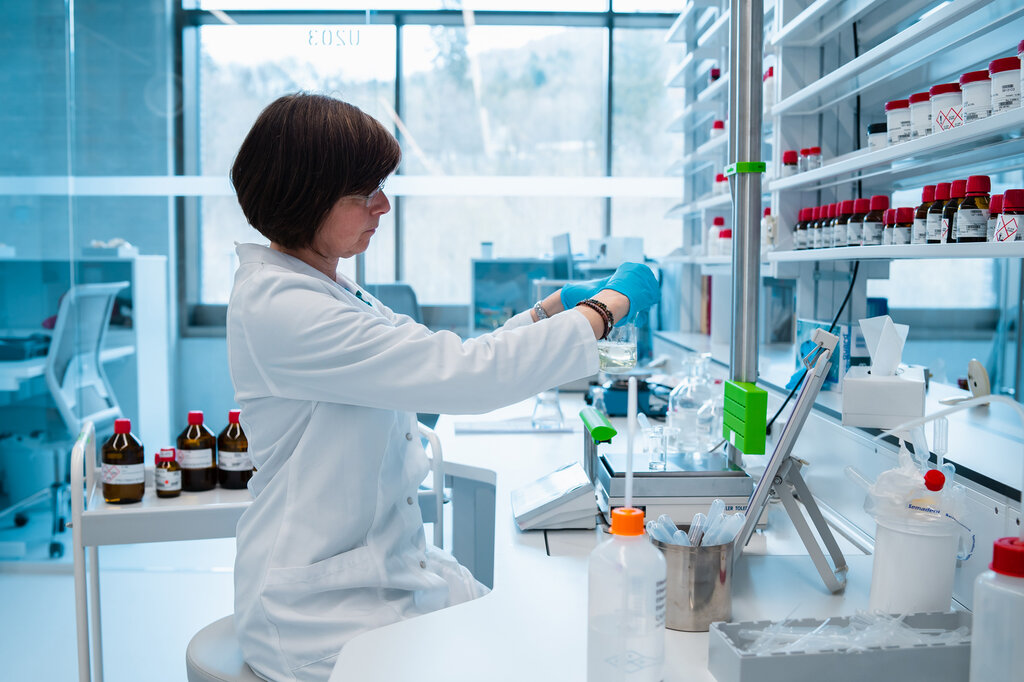
Givaudan’s innovation centre in Zurich. Credit: Givaudan
In a category where failure rates for new products are high, the ability to reduce guesswork is hugely valuable. For Young, the result is not necessarily more radical innovation but fewer obvious misses and more ideas that feel timely and grounded in real consumer demand.
“AI can help identify emerging behaviours, whether that’s demand for high-protein, gut health, or more permissible indulgence, and translate those into more relevant concepts,” Young says.
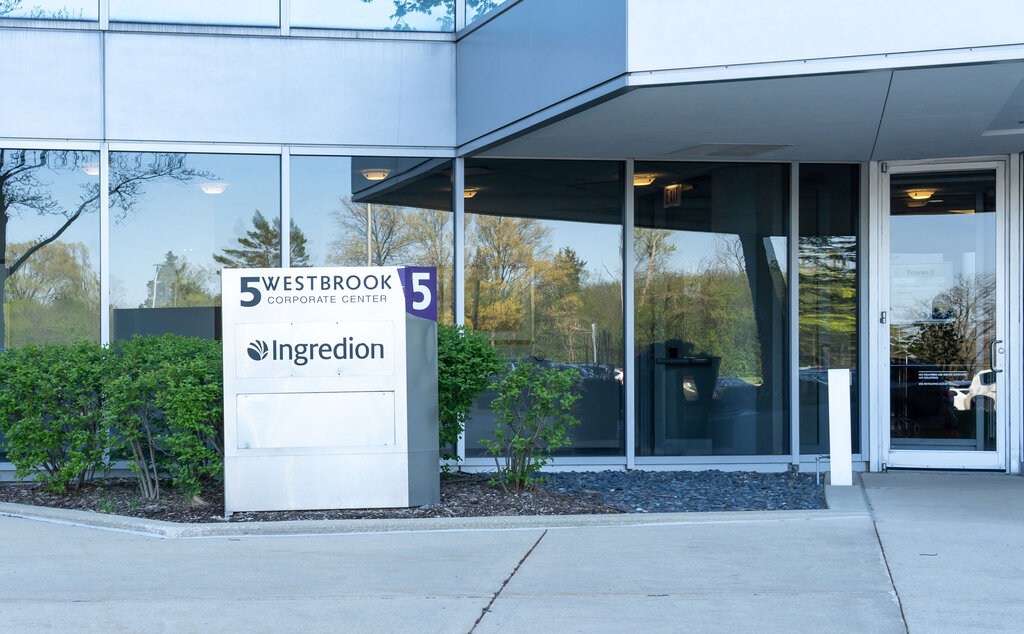
According to Purvi Shah, global innovation business lead for sugar reduction at US ingredients group Ingredion, AI’s chief role in supporting food and beverage product development is in data analysis. Ingredion’s formulation developers use AI to analyse datasets to identify the best combinations of taste and flavour that appeal to consumers, she explains.
Shah says AI is particularly useful for modelling and developing new product formulations that use less sugar without reducing their appealing sweetness – a challenge for food and beverage brands.
Ingredion’s reduced sugar range includes its PureCircle portfolio of sweeteners made from stevia, for use in products including soft drinks, sports nutrition products, baked goods, dairy and plant-based dairy alternatives.
“Using AI, we’ve been able to develop stevia-based solutions that reduce sugar content by up to 50% while still delivering a superior taste experience. Ingredion also offers 100% sugar reduction options that do not compromise flavour,” Shah says.
Credit: JHVEPhoto/Shutterstock.com
Will Telford, co-founder and chief technology and product officer at Point74, a UK-based company offering food lifecycle management software, says one reason AI has been deployed effectively by food manufacturers is the industry already had significant data banks aiding LLMs.
“The real movement we’re seeing isn’t (...) manufacturers dropping standalone AI tools into their workflows; it’s AI being layered over the structured product data that already lives in their product lifecycle management and manufacturing systems,” he explains. “Food companies have spent years curating incredibly rich datasets [including] recipes, cost structures, nutritional profiles [and] supplier specifications.”
Agentic AI
Ai Palette, GlobalData’s innovation and consumer insights platform, which counts FMCG majors like Nestlé, The Coca-Cola Co. and Diageo among its clients, says agentic AI is central to the rapid changes in the use of the technology.
“AI has moved from a back-office curiosity to the engine room of NPD,” Ai Palette co-founder and CEO Som GanChoudhuri says. “The biggest change we’re seeing is that innovation teams are moving from using AI as a research tool to treating it as a collaborative partner that handles the heavy lifting across the full NPD cycle. That’s the shift from AI-assisted to AI-agentic and it's happening faster than most people realise.”
Some companies are deploying AI agents for specific tasks. But these tend to be point solutions.
Click to edit...
Himanshu Upreti, Ai Palette
Ai Palette has developed a new agentic AI “assistant” – dubbed Arya – that the business says can help brands “discover emerging trends in real time” and, ultimately, “make successful innovation decisions”.
“Arya is agentic,” GanChoudhuri says. “It doesn’t wait for a prompt at every step. It can autonomously move through the full innovation workflow, identifying a whitespace opportunity, generating concepts, screening them against real consumer data and producing a validated, launch-ready brief.”
Himanshu Upreti, another of Ai Palette’s co-founders, says the use of agentic AI in food NPD remains in its early stages. Most food manufacturers have moved past experimenting with generative AI and are using the tech for trend analysis, consumer research and content generation, he explains.
“True agentic AI, where the system autonomously executes multi-step workflows without constant human prompting, is just beginning to take hold,” Upreti says.
“Some companies are deploying AI agents for specific tasks – R&D agents that tap into internal KPIs, formulation assistants that optimise recipes, or screening tools that validate concepts against consumer data. But these tend to be point solutions. They handle one step well and then hand off to a human for the next. The full innovation journey, which is from spotting a trend to generating a concept to screening it to producing a launch-ready brief, still gets stitched together manually across multiple tools, teams and timelines.
“That's the gap AI Palette is filling with Arya. What we're building isn't another point solution – it’s a CPG-native agentic assistant that can work through the entire NPD workflow autonomously. Our enterprise customers are already using it to collapse what used to be a months-long, multi-stakeholder process into something that happens in hours, with far richer data inputs and far lower risk of failure.”
Using AI elsewhere in the chain
Telford says AI can also help food companies deal with multiple, often competing and continually changing, economic, commercial and regulatory pressures.
“[Food manufacturers] face constant pressure from every direction: tighter cost targets, high fat, salt and sugar (HFSS) compliance, clean-label demands, retailer requirements and shorter launch windows,” he says. “AI helps compress the iteration cycle, especially during reformulation, where teams used to manually model every possible ingredient tweak just to test one ‘what if’ scenario.”
AI helps compress the iteration cycle, especially during reformulation.
Click to edit...
Will Telford, Point74
AI, proponents says, can also boost energy efficiency and decarbonisation, often challenging for food companies with long supply chains involving ingredients from multiple sources often produced using energy-intensive agricultural processes.
Sam Stark, the CEO and founder of Green Project Technologies, a US-based, AI-enabled carbon management platform, says the technology is helping connect decisions that were historically made separately, such as procurement, product quality and marketing and emissions reductions.
“AI is becoming the common layer” helping staff work from the same data simultaneously, Stark says. “When you can model the carbon implications of a formulation change or a supplier switch before you commit to it, sustainability stops being a constraint on product decisions and starts being an input to them,” he explains.
Stark adds AI surprises many food companies with analysts that says the ingredients driving the highest emissions are often those with the most supply risk, price volatility or geographic concentration. “AI makes that overlap visible in a way that wasn’t possible before and suddenly the business case for acting on it becomes much easier to make internally.”
Nigel Smith, the CEO at TM Robotics, a UK-based robotics distributor specialising in automation for sectors including food processing, says manufacturers use AI-enabled machine vision and robotics to support product development by improving inspection, handling and consistency during early-stage production.
In cheese processing, for example, vision-guided robots can identify and accurately handle irregularly shaped products during cutting and placement, helping manufacturers refine processes for scale-up, while maintaining consistency.
“The main goals are to improve efficiency, reduce waste, strengthen quality control and ensure better repeatability in production outcomes,” Smith says.
What about jobs?
But while AI is said to have many advantages, experts generally agree its role is not to fully replace human involvement in food NPD. “In practice, AI is not replacing human creativity. It’s acting more as a filter or a co-pilot. It can surface patterns and optimise ideas but it still takes human judgement to create something distinctive, emotionally engaging and brand-relevant,” PRS In Vivo’s Young says.
Hayward agrees: “Far from replacing humans, AI can actually highlight their successes; (...) when systems automatically collect and report the data of a team’s productivity or product success, managers, directors and shareholders can [appreciate the people behind the products],” he says.
Finnish dairy giant Valio has seen tangible benefits in its use of AI in product development, Dr. Kevin Deegan, the company’s vice president for innovation, says, pointing to time savings in areas such as translation through to the advantages of “standardising our data infrastructure, finding links and patterns and insights that we can’t see”.
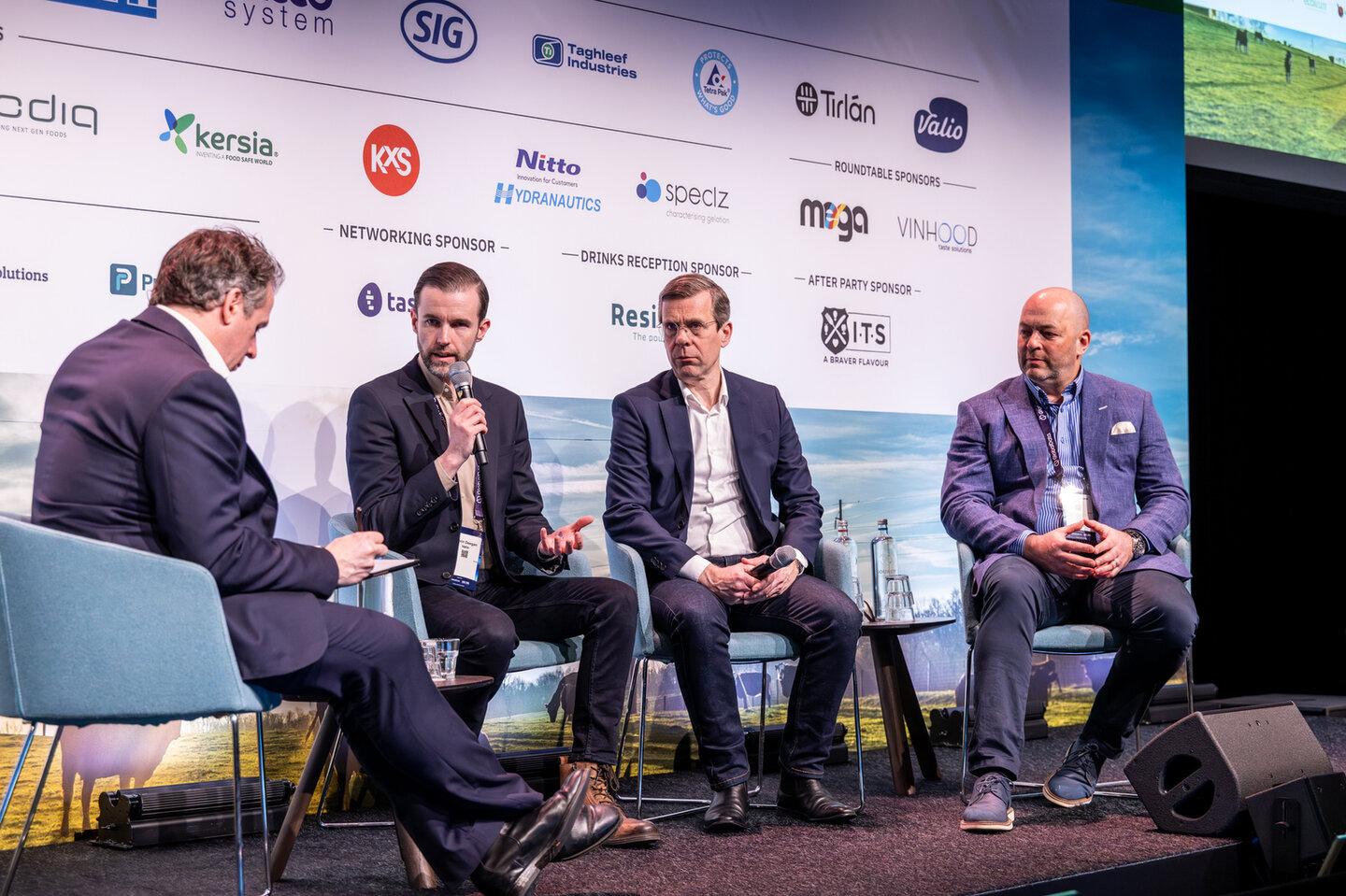
Dr. Kevin Deegan, the vice president for innovation at Valio (second left) speaks at the Arena Dairy Innovation Strategies conference in Amsterdam on 25 March 2026. Credit: Athanasios Psimadis
However, he also says AI can help “enable” Valio’s NPD staff to be more creative, “to test, to prototype, to take chances”.
“It’s not just about how can we do things more efficiently. It’s about where can we get new ideas from. The biggest challenge we have in creativity as humans is our own minds,” Dr Deegan tells Just Food. “A lot of people believe ‘I’m not creative. I’m a doer.’ In some level, we’re all creative as children, as babies, if you see how they explore, how they experiment. They don't fear failure. All of these things are learned as we get older. How can we use that to unlearn or to test or to reduce the risk of trying these things? A lot of it comes down to are you willing to raise your voice and suggest something? Can we reduce that uncertainty and risk by using things like AI?”
The biggest challenge we have in creativity as humans is our own minds.
Click to edit...
Dr. Kevin Deegan, Valio
Dr Deegan concedes it’s “human nature” for staff to wonder what the impact of AI on jobs might be but he believes the technology can help staff in their roles.
“If we think about it in terms of creativity, think about it in terms of finding focus in your own work, that has to be the approach that’s taken,” he says. “The approach we’ve taken from it is what’s the biggest reason why innovation doesn’t happen? Everybody says lack of time.
“We need to start challenging that because are we ever going to have time? We have more tools. We have more conveniences that we’ve ever had before. Does it mean that we have more time? It’s debatable. Is there something that AI could do in order to free up your time, to give you the time to think like beyond the next year, beyond the next two years?”
He adds: “That’s what we need to be doing as well. In our home markets, we’re market leaders in many of the categories. The market leader’s responsibility is not just to grow but it's also to bring the new ideas and to challenge the category and challenge the market itself. It can’t be the routine. It can’t be keeping the engine running. It has to be thinking outside the box, looking into the future.”
Additional reporting by Dean Best.
