Interview
“Gut health is just a better way of eating” – Bio&Me’s Jon Walsh on fibre coming back into fashion
Bio&Me co-founder and CEO Jon Walsh talks to Dean Best about how the up-and-coming UK brand is looking to capitalise on the rising consumer interest in gut health and in fibre.
Main image: Jon Walsh, co-founder and CEO of Bio&Me
B io&Me, a UK food and drinks business focused on gut health, is growing rapidly, carving out a foothold in its home market with a range of high-fibre products on sale across the country’s largest grocers.
“It’s great fibre is having its moment in the sun,” Jon Walsh, the food-industry veteran who set up Bio&Me in 2019 with Dr Megan Rossi, tells Just Food. “Fibre has been spoken about for a long time but it’s always been seen as a bit worthy, bran and prunes. There’s been no joy in it.”
Dean Best: You’ve said gut health is having its moment. Why do you think that is?
Jon Walsh: I think it has been for a long time, five, six, seven years. Covid really increased people’s interest. The difference about gut health is it’s not a fad. Do you remember fad diets like Atkins, etc, that really peaked and then troughed afterwards? Gut health, at its heart, is just a better way of eating. It’s basically just talking about diversity of fibre, what more things to get in as opposed to get out.

They know gut health is important but they don’t want to have to get a PhD to work out what the right things are.
It’s always been this steady [growth], each year more people have switched over. Now there is noise about it and part of that is people like Megan, [UK epidemiologist and Zoe co-founder] Tim Spector, doing a lot of the education work. Then, if you jump to this year, there is a social media fibremaxxing thing. Fibre, which has been all about brown, bran and poo basically for 30, 40, 50 years, is now having a sexy moment and that’s great. Long may it continue.
Protein is a good thing but there is no deficiency of protein in this country. It’s good for people to eat more but they’re eating plenty whereas fibre really will help you be healthier and better. I want people to carry on eating more protein but they need to be eating more fibre.
Dean Best: What types of consumers are showing more interest in gut health? To what extent have you got a feel for the percentage of the population that really is showing an interest?
Jon Walsh: We do have some data. Thirty-four per cent is the number that we have. Within that, there is a very small and very knowledgeable group who really know what they’re doing, which is probably two, three, four per cent. Then there is the next 30% who want to do the right thing and would just like simple solutions, simple messages.
They know gut health is important but the one thing they don’t want to have to do is get a PhD in order to work out what the right things are. From a growth, business point of view, our job is to help that 30%, give them the easy clues, so they can take it off their list and not worry about it anymore.
Dean Best: What role can convenience play to get more consumers interested?
Jon Walsh: Listening to our consumers, quite a lot of them define convenience as ‘Don’t make me give up my favourites.’ They like their cereals, their yogurt. Simple switches is convenience for them. Then there is the convenience which is ‘I’m out and about, I just want to grab something on the go.’ We’re only just starting there. We launched our bars about a year ago. We’ve got porridge pots. We’ve got our new, smaller kefir drinks launching.
Dean Best: As more consumers show interest in gut health, do you think they’ll become more discriminating about the types of products they believe can help? It’s going to be more important for companies like yourselves to demonstrate you’ve got the evidence to back up your claims.
Jon Walsh: I hope so and I think history probably suggests that’s true. If we compare against protein, where the race was just on how many grams can you put in, if the race on gut health is about the evidence [and] about maybe the number of different fibres, brilliant. We would love that. I don’t see that happening yet but I would love the market to go there.
Dean Best: Is it still too early for the average consumer to be educated enough to start interrogating product claims and recipes?
Jon Walsh: A little bit. On claims, I would encourage people to do it the right way because, if too many brands either by accident or deliberately choose to make incorrect claims that undermines consumer confidence.
Also, I think – and we’re still working on this, all brands are – gut health is a more complicated topic. Protein is as simple as big muscles, more grams, there you go. That’s the story and, gosh, it’s worked. Whereas gut health, there’s fibre and the live and active cultures, you are talking about the digestive system, which, for most people doesn’t conjure up images of lovely food, quite the opposite. It is a little bit more of a complicated story but it’s now really starting to happen and I think people are getting more interested.
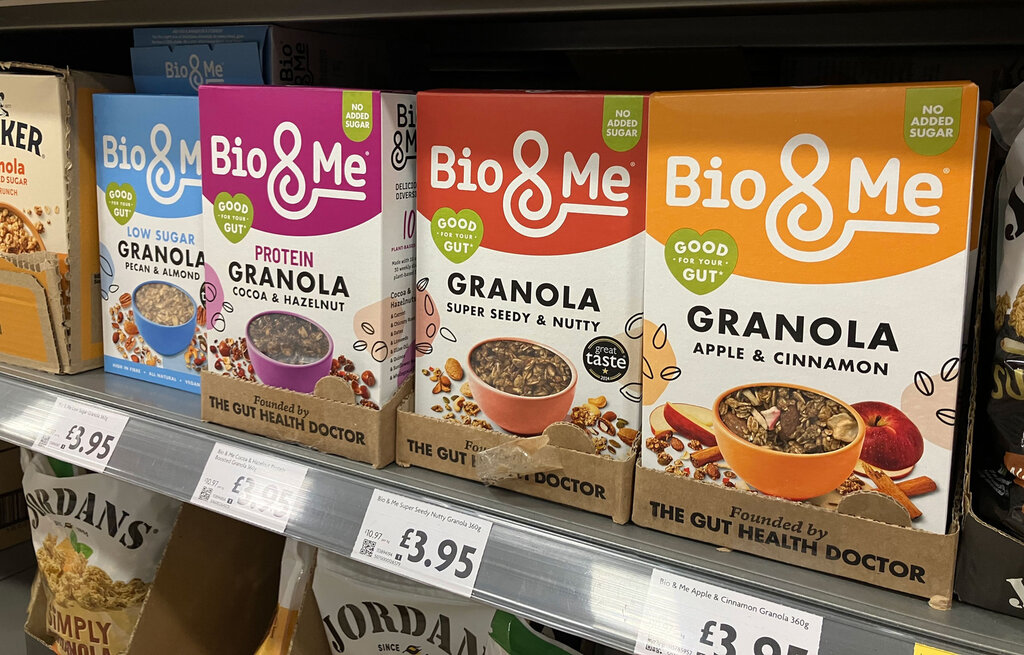
Bio&Me granola on sale in Morrisons, Sidcup, London on 22 April 2026. Credit: Just Food
Dean Best: You’ve posted on LinkedIn recently that Bio&Me had achieved sales “now far over the £20m mark”.
Jon Walsh: How we do it is quarterly, annualised run-rate. Obviously, we’re growing, so by the end of the year, we’ll be well above that. It’s the last quarter’s run-rate.
Dean Best: What are you forecasting for net sales for this calendar year and what would that represent in year-on-year growth?
Jon Walsh: £20m. That would be about 45% growth versus last year. We really are seeing very strong growth.
Dean Best: What’s driving that growth?
Jon Walsh: Happily, we see our repeat rates going up, increasing over time. As you’ll know, that’s helped by distribution gains as well but the magic number on repeat rates is 40% and we’ve gone over 40% on our key lines, which is fantastic. In the past, the majority of our growth came from distribution gains. The support we’ve had from the supermarkets is fantastic. The good news for us and them is, though, the majority of our growth now is coming from increased rates of sale.
Dean Best: What are your forecasts for 2027 or 2028, say? Can you disclose those?
Jon Walsh: I better not but we’ll keep adding more cash each year. It’s obviously harder to keep the percentage the same but percentages would stay very strong. Thirty per cent year on year, that sort of level. We can feel it in the market at the moment. Without giving the exact numbers, it’s a very nice curve.
Dean Best: Are you making a net profit?
Jon Walsh: Yes, only just. It was lovely for the team because financiers are always very good at pointing out ‘Oh, you’re good at raising money, you’re good at spending it’ kind of thing. The team knows you can only run for so long if you’re in the red. Being a sustainable business – we’re very proud of B Corp and all the rest of it – you’ve got to do the right things environmentally and socially but, if you want to keep existing and doing that, you need to be profitable.
We moved into profit in the middle of last year. Quarters one and two, we invested and then we made money in quarters three and four. We’ll be profitable again this year. We don’t want to be profitable by very much. I call it ‘positive break-even’. We want to take all the extra margin and invest into growth.
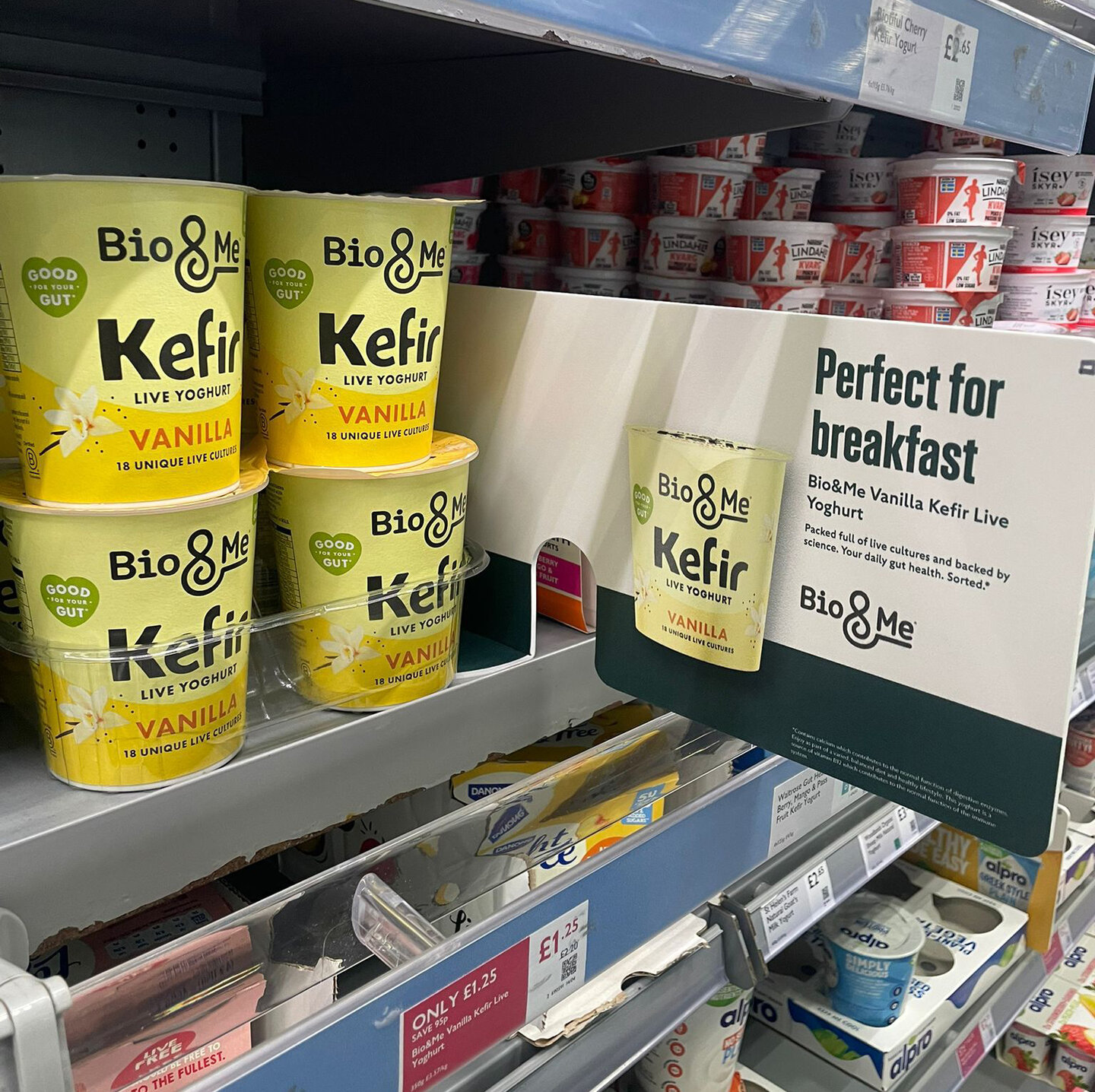
Credit: Bio&Me
Dean Best: How much investment has the company raised so far?
Jon Walsh: We’re seven years old now. I think over the first five years, we raised about £4.5m. We haven’t raised anything for the last two years because basically we’ve been break even, so haven’t needed to.
Dean Best: Are you looking to go back to the market to try and raise more money to help you with your growth plans?
Jon Walsh: The current plan is not. Plans do change and, if opportunities come along, then we’d look at them. There are big bets out there. We haven’t done any acquisitions, for example. International, we’ve stayed focused on the UK. They require capital. I think, right now, we just want to make the UK as big as we can as fast as we can and keep that profitability going and then we’ll decide in a year or two, whether we want to change.
Dean Best: Is the company not considering any moves outside the UK at the moment?
Jon Walsh: We’re looking at it. We haven’t made any decisions but we are, I would say, now properly looking at it and doing all the work you would expect from a strategy point of view. It’s a big decision, though. People talk about them a lot quieter but there are many brands who have got a lot of scars from trying to go internationally. They spend a lot of money and it hasn’t worked. If and when we do it, we’ll do it very carefully.
Dean Best: What do you see as the growth opportunities for Bio&Me in the UK?
Jon Walsh: We still have a long way to go on the whole marketing, branding side. Our rates of sales are good but there’s plenty more to go after. Number two is around e-commerce. Ninety-five per cent of our sales go through the supermarkets. Then we have NPD, our new drinks coming through, there’s lots of NPD around our granolas.
We want to be mainstream. We want everybody to have good gut health.
Now that we’re profitable, we’re starting our charity partnership with Bowel Cancer UK, which I’m particularly proud of. That is good from a purpose point of view and I think that will be good from a growth point of view as well.
Dean Best: As consumers think about what to buy, how much do you think charity partnerships and B Corp certification influence their decisions?
Jon Walsh: Ask me in a year’s time and I’ll be able to tell you better. My honest suspicion is it’s more at the reassurance level. People are much more interested in the values of the companies they’re buying but I think that’s probably more for our loyal users to feel good about us, feel good about themselves. If we were to see metrics move, I imagine it would probably be more on the loyalty side than the trial side but who knows? We’re going to find out.
Dean Best: Speaking of trial, what about your pricing? You’re a small brand, growing, but small. There’s the scale factor to think about. It’s probably unfair to compare you to a Jordans but, when you look at the granola fixture, there are a range of prices. Might gut health continue to be the preserve of more affluent consumers because the products are relatively more expensive?
Jon Walsh: Well, I hope not. I suppose one of the data points that makes us proudest is – to the degree to which the supermarkets still do serve the different socio demographics – we do well in Asda and we do well in Morrisons and we’re proud of that. We’re seven years old. We’ve only put through one price increase in those seven years, which followed Ukraine because we had to. Whereas especially some of the larger,cereal companies, my word, they put through, four or five. We’ve become relatively better value over time and we’re going to try and keep doing that.
As we grow, of course, that means we can buy bigger bulk. Our relative pricing has improved. We do have better ingredients for gut health, so there is a small premium but, honestly, it’s only about 10%. It’s not as much as you might think. The fact it’s so small is helping drive our growth because people will trade up for that.
We want to be mainstream. We want everybody to have good gut health. Even with everything else going on now. We use date paste to bond the granola because that’s natural. It turns out Iran grows a third of the world’s dates. My God, the fun and games finding containerfuls of date paste that we can buy but we found it and, right now, have no plans to pass on any cost increases. We want to try and keep it as low as we can.
