Company Insight
Sponsored by Cornish Sea Salt
Salt reduction risks repeating the low-fat mistake, but there is a better way forward
By Philip Tanswell, Managing Director, Cornish Sea Salt
Main image: Philip Tanswell, Managing Director of Cornish Sea Salt
A new generation of mineral-balanced salt solutions is reshaping how the food industry approaches sodium reduction. Innovations such as TekSalt™, developed by Cornish Sea Salt, show it is possible to reduce sodium while maintaining, and even enhancing, taste. Without a shift in approach, however, the industry risks repeating a familiar mistake.
As manufacturers accelerate sodium reduction, many early strategies have relied on potassium chloride as a direct replacement. This first-generation approach treats sodium reduction as a simple one-for-one swap. While it can help meet targets on paper, it often creates new taste challenges.

Caption. Credit:
At higher levels, potassium chloride can introduce bitterness and metallic notes that are difficult to mask, especially in premium products where flavour integrity is critical. This creates a practical ceiling on how far sodium can be reduced before consumer acceptance is affected.
In that sense, it risks echoing the low-fat era of the late 20th century, when reformulation often solved one nutritional issue but created another.
Back then, fat reduction became a major trend. “Low-fat” products proliferated, but sugar and refined carbohydrates were often added to compensate for taste and texture loss. The result was not inherently unhealthy products, but poorly balanced formulations. The lesson remains relevant: focusing too narrowly on a single nutrient rarely delivers a complete solution.
Today, sodium reduction risks following a similar path
More fundamentally, it overlooks an essential principle: both human physiology and flavour perception depend on balance, not substitution.
Electrolytes such as sodium, potassium, magnesium, and calcium work together to regulate hydration, nerve function, and cellular activity. In food, flavour is also shaped by the interaction of multiple minerals, creating depth, roundness, and continuity rather than relying on sodium alone.
This is where next-generation thinking is emerging
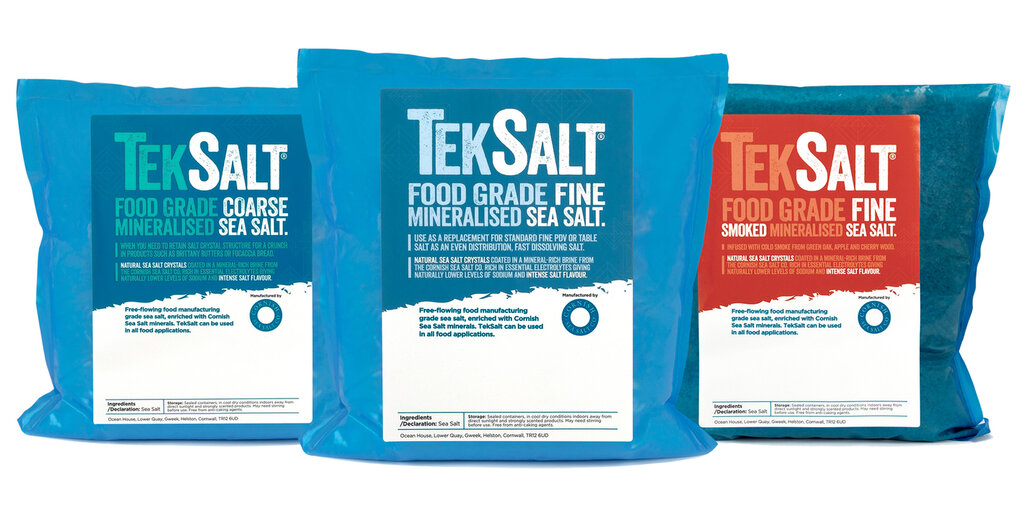
Rather than single-ingredient substitution, mineral-balanced salt solutions are designed to restore the natural spectrum of electrolytes found in sea salt. TekSalt™ represents this approach. By leveraging the inherent mineral profile of sea salt, including calcium, potassium, and magnesium, it delivers high taste intensity with reduced sodium, without relying on high levels of isolated potassium chloride.
Caption. Credit:
Importantly, TekSalt™ is commercially aligned with other sodium reduction solutions, helping avoid the assumption that premium sea salt-based approaches come with higher cost. It is also engineered to be free-flowing, ensuring consistent dosing, ease of handling, and reliable performance in manufacturing environments, without the irregular texture challenges technical teams might expect.
This shift from first-generation replacement to mineral balance is significant for manufacturers. It reduces the need for extensive reformulation, supports sodium reduction targets more effectively, and helps maintain the sensory qualities that drive repeat purchase. Early adoption across UK food manufacturing and foodservice suggests it is both technically robust and commercially practical.
The broader point is simple: sodium reduction should not be treated as a substitution exercise
The real challenge is delivering products that meet health expectations while still satisfying consumers. When that balance is lost, products may meet nutritional targets but fail in the market.
There is now an opportunity to take a more considered path
By moving beyond potassium-based approaches and embracing solutions that reflect the natural complexity of salt, the industry can avoid repeating past mistakes. The goal is not just to reduce sodium, but to do so in a way that preserves flavour, functionality, and consumer trust.
Get that balance right, and sodium reduction becomes not a compromise, but a genuine step forward.
Contact information
Cornish Sea Salt
Email: sales@cornishseasalt.co.uk
Web: www.cornishseasalt.co.uk/teksalt