Feature
Confectioners seek paper packaging sweet spot
Facing challenges with cutting plastic, the world's largest confectioners are testing paper packaging but progress remains patchy. David Burrows reports.
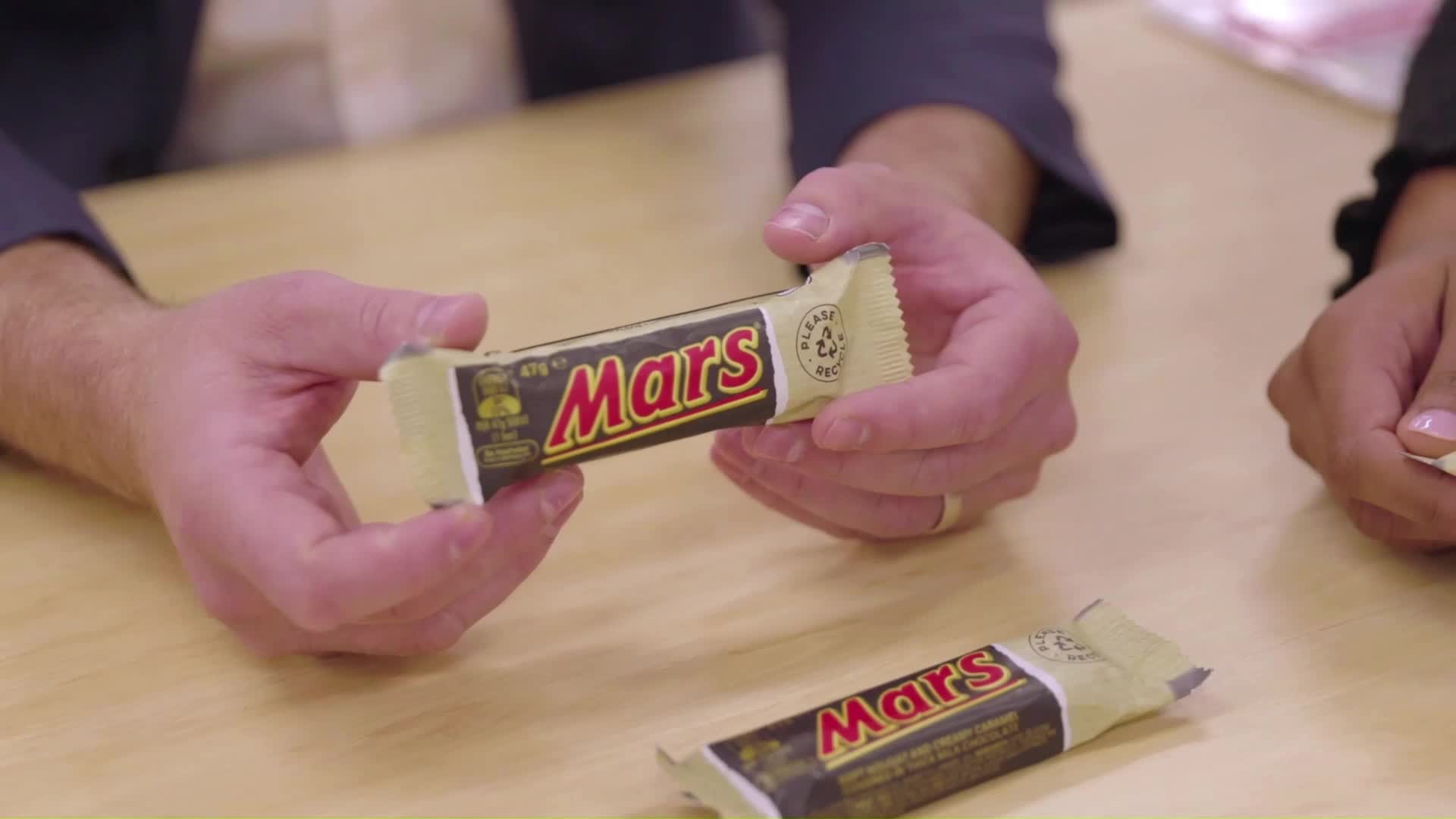
Main video credits: Mars
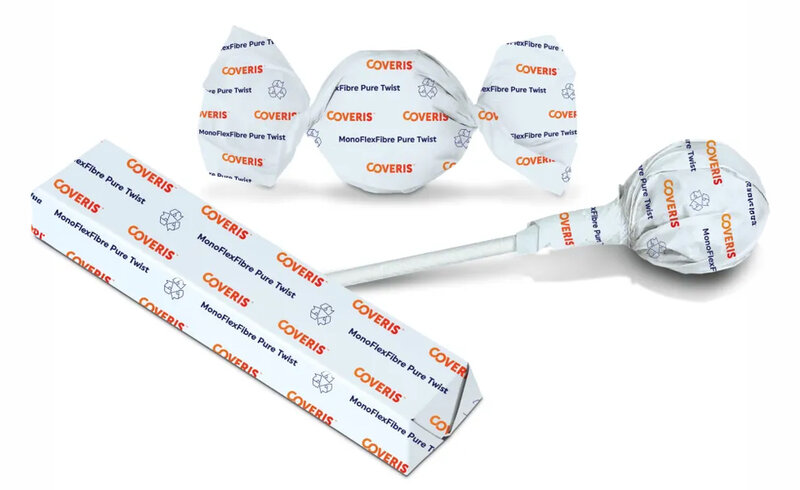
This from a product announcement in April: “a single layer of lightweight material, offering a reliable seal as primary packaging for single- or double-twisted candies, chocolate pralines and lollipops, as well as for heat-sealed chocolate bars in flow packs. Digital printing on this packaging is also pretty straightforward and ‘recyclability’ is in line with new regulations across the EU”.
That last characteristic provides the biggest clue as to the material in question. This is not flexible plastic – for decades the cheap, functional choice for brands – but fibre. Or rather 95% paper and no more than 5% plastic – in line with the EU’s 95/5 rule within the bloc’s packaging and packaging waste regulation (PPWR). While purveyors of single-use plastics for confectionery continue to struggle to join the circle on their polymers – recycling plastics back into food-grade flexible plastics – innovation in paper packaging continues to attract investment and encouragement. Hoops are being jumped through and faster than some thought possible.
“Switching to this paper structure requires no major modifications to existing machinery and can be efficiently implemented on high-speed and standard FFS [form-fill-seal] packaging lines,” Coveris, the packaging producer behind the new paper-plastic wrappers in the release, says.
Whether such innovations can be scaled and considerably reduce reliance on plastics remains moot. There is a sweet spot that needs to be hit.
Caption. Credit:
Consider the performances of major confectioners towards their voluntary plastic targets. Mars, Mondelez International, Ferrero and Nestlé have all struggled to reduce their reliance on virgin plastic, according to 2024 figures published by the Ellen MacArthur Foundation (EMF), a think tank, at the end of last year.
Some of these companies sell more than sweet treats, yet their continued reliance on hard-to-recycle flexible plastics is a persistent problem for packaging teams. Almost half (49%) of Mars’ packaging is flexible plastics. At Ferrero it is 25% and Mondelez 68%.
Last month, the Cadbury owner published plastic packaging data for 2025, showing some progress: an 11.5% reduction in the use of virgin plastic (versus a 5% target). However, its use of plastic recycled content (or post-consumer recycled plastic, PCR) is just 3.7%.
Integrating food-grade recycled plastic into ‘new’ packaging is tricky. Ferrero managed 5.8%, Nestlé 14.7% and Mars 7%, according to EMF. Collections of flexible plastics are limited and heavily contaminated, while food safety regulations are strict. But there is hope that solutions can be scaled before the end of the decade.
Last month, Coveris and Nextek announced the start of industrial-scale trials at a processing plant in the UK, which will convert post-consumer polyolefin (PE and PP) film waste into “high-quality recycled resin”.
Nextek founder Edward Kosior explained how technologists had told him it “could not be done” but, after a feasibility study on improved decontamination and “three years of intensive R&D to validate the process conditions and scalability of the process”, the work at scale now begins in Lincolnshire. Mind you, it will take two years to generate the data required by European regulators to approve the recycled plastics for food-grade applications.
Change is taking time and money. Mondelez, like other major food companies, has moved the goalposts on some of its ESG targets, including for packaging. “Due to rapidly evolving regulations, changing consumer and customer needs, the complexity of implementing novel packaging solutions across a complex global network and the slower-than-anticipated scaling of circular systems, we now aim to achieve our designed to be recyclable, recycled plastic content and virgin rigid plastic reduction goals by 2030,” the Milka and Sour Patch Kids owner says.
The large confectioners continue to stare huge plastic footprints – and continued NGO and regulatory pressure – in the face. Can they afford to wait for a circular solution to their flexible plastic waste, or do they continue to seek alternatives, like fibre?
Credit: Bjoern Wylezich/Shutterstock.com
Chasing paper; creating problems
A recent report by EMF suggests there is some wisdom in chasing paper. “Paper could play a valuable role in tackling plastic pollution, providing an alternative to flexible plastic packaging,” the report, endorsed by the likes of Mars, PepsiCo and Nestlé, as well as NGOs including WWF and Canopy, concluded.
Flexible plastic packaging accounts for 80% of the plastic packaging entering oceans. Countries like India and Indonesia are awash with small format products – food and non-food – that are not only hard to recycle but also hard to capture due the lack of collection infrastructure. It’s clear the need for alternative solutions is pressing. However, as Nicole Rycroft, executive director for not-for profit Canopy, warns, brands must resist a temptation to “jump from the plastics ‘frying pan’ into the paper ‘fire’.”
This was certainly the case when food and drink brands first came under scrutiny for their use of unrecyclable plastics. Today, approaches tend to be more nuanced. EMF’s experts, and those they consulted including Rycroft, don’t call for a widespread flip to fibre. Fibre alternatives must meet certain criteria, including the need for the packaging to be responsibly sourced and produced, free of hazardous chemicals (a high-profile problem for paper as well as plastic packaging), functional and economical, as well as widely recycled locally (similar boxes should be ticked regardless of the packaging material).
Nestlé sees “well-designed, responsibly-sourced paper” as “one of the viable solutions against plastic pollution”. The KitKat owner has managed a 28% reduction in virgin plastic, just shy of a stretching target of 33% by 2025. The company is responsible for 318 billion pieces of packaging (all materials) annually, according to its 2025 “non-financial statement”, which provides an overview of “sustainability-related areas where we may have an impact on our surroundings (positive and negative), as well as risks that may have a notable financial impact on our company”.
It reads: “As we adapt to shifting consumer preferences and regulatory landscapes, the transformation of our product portfolio – especially the transition to plant-based proteins and paper-based packaging – requires a rigorous early assessment to avoid unintended environmental or social consequences. Our two areas of particular focus relate to the risk of contributing to deforestation through new sourcing practices and the potential social impacts associated with shifts in supply chain origins.”
Credit: Richard Juilliart/Shutterstock.com
Much has been made of the problems created by rising reliance on paper, which is still perceived as ‘more sustainable’ in pretty much any consumer survey. Use of a plastic layer, or adhesives and barriers that are often shrouded in mystery, is either ignored or invisible – much to the chagrin of the mills trying to recycle the ‘paper-plus X’ packaging.
Supply chains are working closer together, designing packaging fit for recycling streams rather than dumping the problem on waste processors with packaging that is technically but not practically recyclable. Brands are also doing their best to communicate to consumers where the ducks are not quite in a row. Mars and Snickers, for example, come in paper-based packaging in Australia and New Zealand but can’t be recycled in the latter due to “infrastructure differences” and “recently revised technical guidelines”.
Regulations, like the 95/5 rule in the EU, are important, ensuring recyclability in paper streams and potentially reducing extended producer responsibility (EPR) fees.
EPR systems are at the heart of the solution to prevent a shift back to virgin materials and to drive the increased use of post-consumer recycled (PCR) content across all plastics, as mandated by the EU’s PPWR from 2030, too. Well-designed EPR systems create the foundation for effective collection and sorting, helping to provide recyclers with a stable, cost-efficient supply of feedstock, Mark Roberts, director for circular economy at packaging group Amcor, tells Just Food.

With the right barrier performance, paper can deliver the protection needed for demanding applications like chocolate.
Janice Narainsamy, Amcor
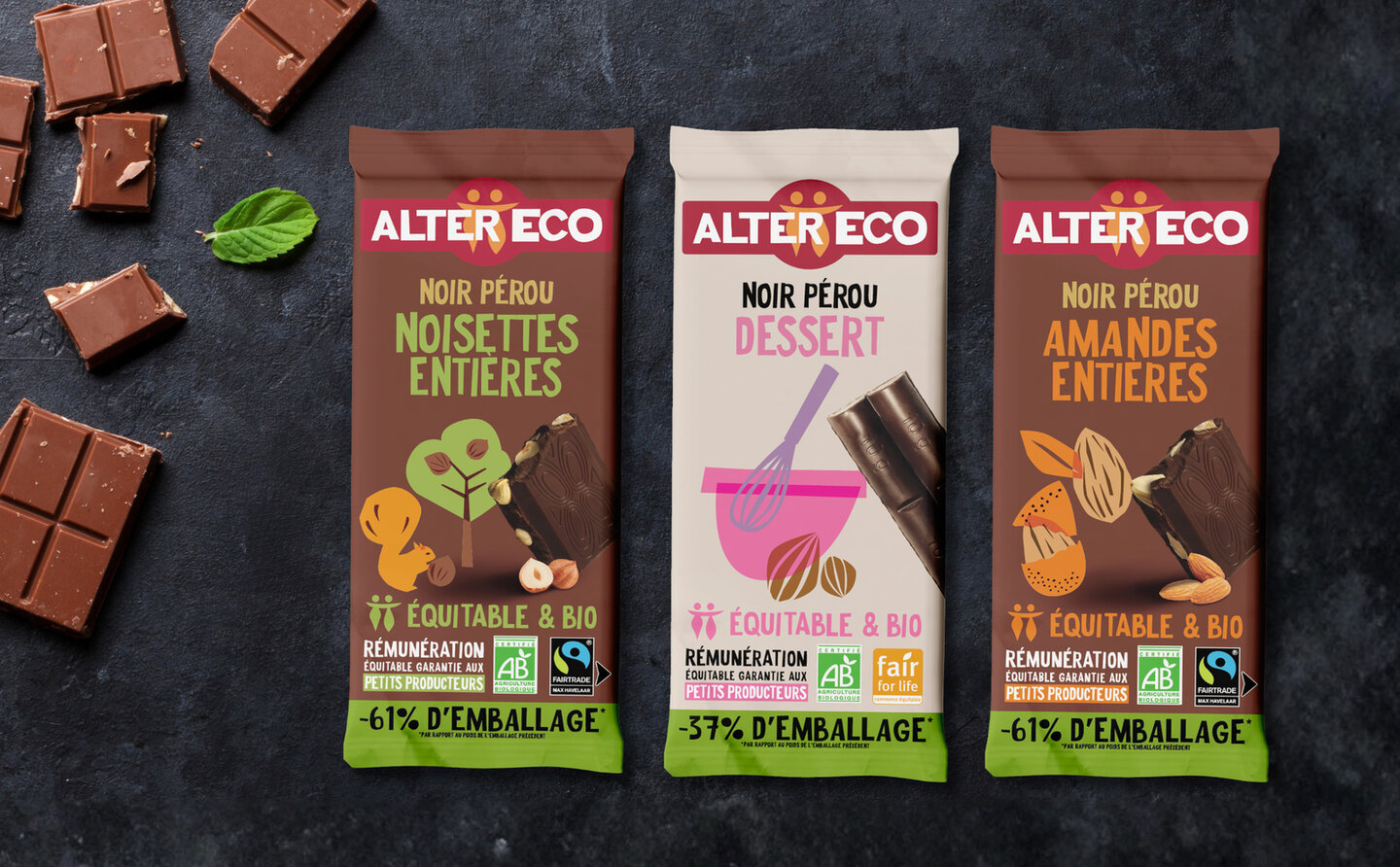
In February, Amcor partnered with French organic snack producer, Alter Eco, to introduce a recyclable, paper-based and reduced-weight packaging solution for their 200g chocolate range. The paper-based packaging provides protection against water vapour and grease. It also maintains a smooth, high-quality appearance despite the textured surface on an SKU that contains almonds. Weight was reduced in the packaging, which can be recycled through the paper stream in France.
“With the right barrier performance, paper can deliver the protection needed for demanding applications like chocolate”, Amcor senior product development engineer Janice Narainsamy says. “Paper-based packaging combines strong shelf appeal with a well-established perception of sustainability.”
Credit:Amcor/Alter Eco
Paper’s appeal
According to a survey carried out across 42 countries by GlobalData, Just Food’s parent, a quarter of consumers globally consider recyclable packaging an essential characteristic in the products they buy and almost half see it as a nice-to-have.
This consumer appetite for ‘sustainable’ options, alongside regulation globally, is helping the use of paper packaging gain momentum, GlobalData consumer analyst Naveed Khan says. It presents “significant opportunities for manufacturers to innovate, enhance their brand image and expand their market presence”, he adds.
But how about the trees? Every year, billions are felled to make paper packaging, potentially leading to deforestation and contributing to climate change. And paper’s popularity means more trees.
“Whether forests can keep up with demand for paper is a complex issue, particularly as demand for many kinds of wood-derived products is growing,” Tallulah Chapman from the Forest Stewardship Council in the UK, tells Just Food. “There are, however, initiatives to plant more trees and expand forest area; together with recycling, this can help to mitigate impact.”
As demand grows, the need to ensure that sourcing is responsible becomes even more important. Alter Eco’s paper is FSC-certified, for example. As Chapman suggests, companies large and small must ensure that they do not simply assume and promote paper packaging as a sustainable solution without ensuring responsible sourcing. The regulatory net is tightening, thanks to the EU Deforestation Regulation (EUDR) and new rules relating to green claims.
Also tightening are margins and supplies. Cost has always been a barrier to paper-based packaging, especially the innovative new flexible formats. However, the conflict in the Middle East may well change the game. Just Food sister site Packaging Gateway has reported how the packaging industry is being hit by the crisis through higher plastic prices, disrupted shipping and rising energy costs.

U.S. conducts blockade operations near Strait Of Hormuz. Photo by Handout / Handout via Getty Images
Reuters has reported switches from plastic to paper are already happening as prices for polyethylene (PE) and polypropylene (PP) hit four-year highs following disruptions to oil and petrochemical flows through the Strait of Hormuz. The plastics recycling sector in Europe is already facing cost pressure, leaving brands looking for resilient, low carbon alternatives.
Whether paper is one of them remains unclear (life cycle analyses on paper-based versus plastic packaging can be a rabbit hole). The war has placed pressure on paper packaging companies, too. Last month, Mondi, which makes rigid and flexible packaging, said prices will rise later this year as “challenging market conditions” and “cost pressures linked to escalating political tensions” weigh on its earnings.
Less is more
Increasingly, there is no place to hide from rising costs when it comes to packaging. NGOs will, once again, point to the resilience offered by reuse and refill systems. Research led by Dutch academics shows willingness to adopt these approaches in categories where packaging is seen to be “excessive”, including confectionery. “Participants also reported that engaging in similar types of self-service (e.g. buying bulk candies, filling freshly-squeezed juice in bottles) and reuse systems (e.g. returning empty beverage bottles to the deposit-refund system) could help them switch to reusable packaging systems,” the experts wrote in their paper for Resources, Conservationand Recycling. However, uptake across FMCG in reuse remains minimal.
The real question is whether switching from plastic to paper-plastic composites truly helps the environment.
Kara Brown, Bee Inspired
Rising costs and limited supplies might not move the needle on reuse but it will force companies to reduce single-use packaging. Kara Brown from Bee Inspired, an artisan confectionery brand that makes lollipops in the US, says: “What’s often missed in the paperisation debate is that focusing on wrapper format is the wrong place to start. The real question is whether switching from plastic to paper-plastic composites truly helps the environment, or if it just protects the brand’s reputation. These are two different results that often get confused.”
From a consumer perspective, paper carries strong positive associations. It signals sustainability, simplicity and progress, often acting as a shorthand for ‘better for the environment’ at shelf, Patrick Young, managing director at PRS In Vivo, an international consultancy specialising in packaging and shopper habits, says. “In a category like confectionery, where purchase decisions are fast and emotionally driven, those cues can be powerful,” he tells Just Food.
But there’s a tension between perception and experience – and one which brands are striving to overcome as they look past plastic. “Confectionery is one of the most sensorial categories in retail,” explains Young. “The crinkle of a wrapper, the ease of opening, the ability to reseal or share, all play a role in how satisfying the product feels. Paper-based or paper-mix materials can change that experience.”
